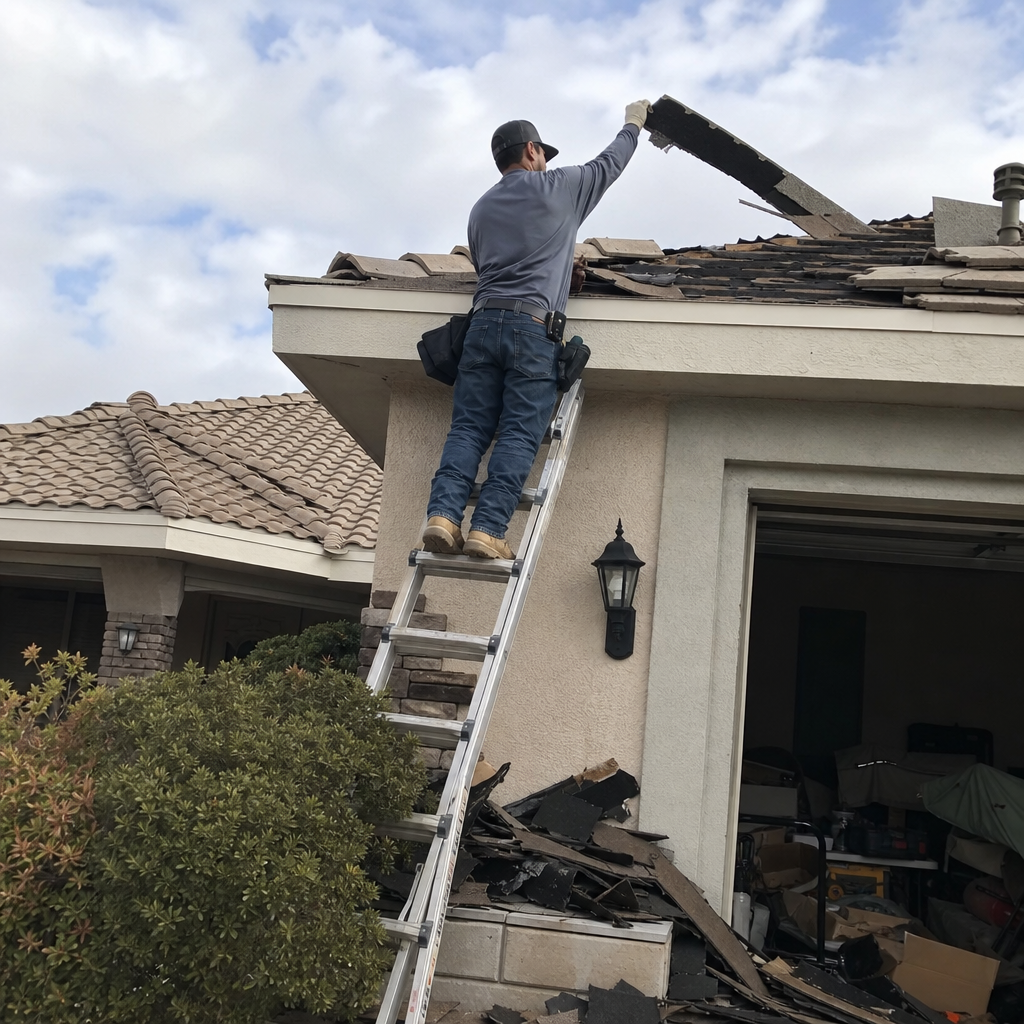
Emergency & Storm Damage in Nellis Air Force Base, NV
When a high-wind event tears edge flashing off a low-slope roof in the Sunrise housing area, the clock starts immediately — but inside Nellis Air Force Base, the standard “call a roofer, they show up in an hour” model simply doesn’t work. Our Emergency & Storm Damage team at Premier Roofing & Construction is structured specifically to operate inside the fence line: pre-credentialed, familiar with DoD Unified Facilities Criteria, and with materials staged off-base so we’re not burning a second access window waiting on a supply run. For urgent roof situations at Nellis AFB, call us at (725) 373-5602.
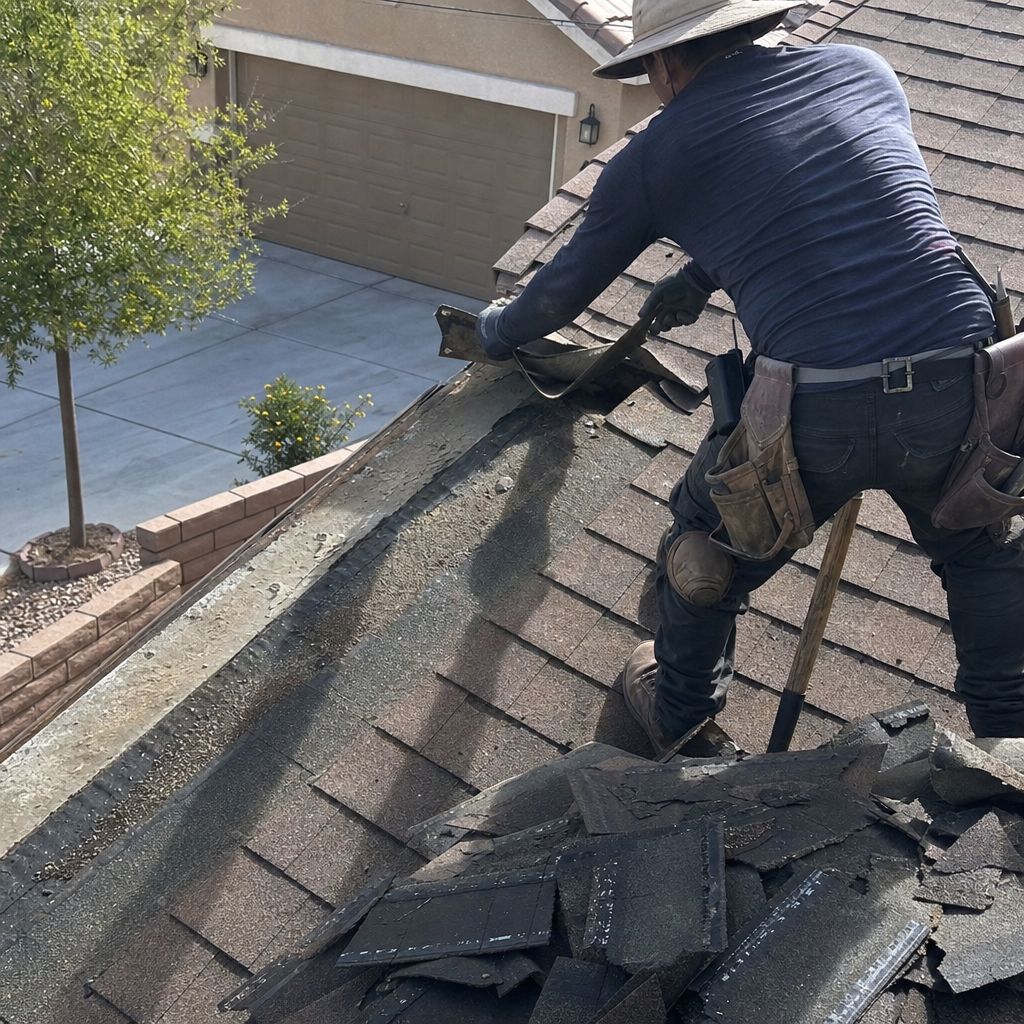
Why Premier Roofing & Construction Is Nellis Air Force Base’s Preferred Emergency & Storm Damage Company
Nellis Air Force Base, zip code 89191, presents a credentialing and coordination challenge that eliminates most roofing contractors before the job even starts. Owner and Lead Technician Karen Gomez built our access protocols from the ground up — pre-cleared personnel, a working relationship with the installation’s civil engineer squadron, and off-base material staging so we’re ready the moment an access window opens. That preparation is the only reason fast emergency response is genuinely possible here.
613 homeowners and facility contacts have left us a perfect 5-star rating — and a meaningful portion of that trust was earned through exactly this kind of logistically complex, high-stakes work. When our Nellis Air Force Base clients call after a storm, they’re not explaining the base-access problem to someone who’s never dealt with it. Karen has. The crew has. We’ve already done the paperwork before you needed us.
Our Emergency & Storm Damage Services in Nellis Air Force Base
Emergency Tarp Installation
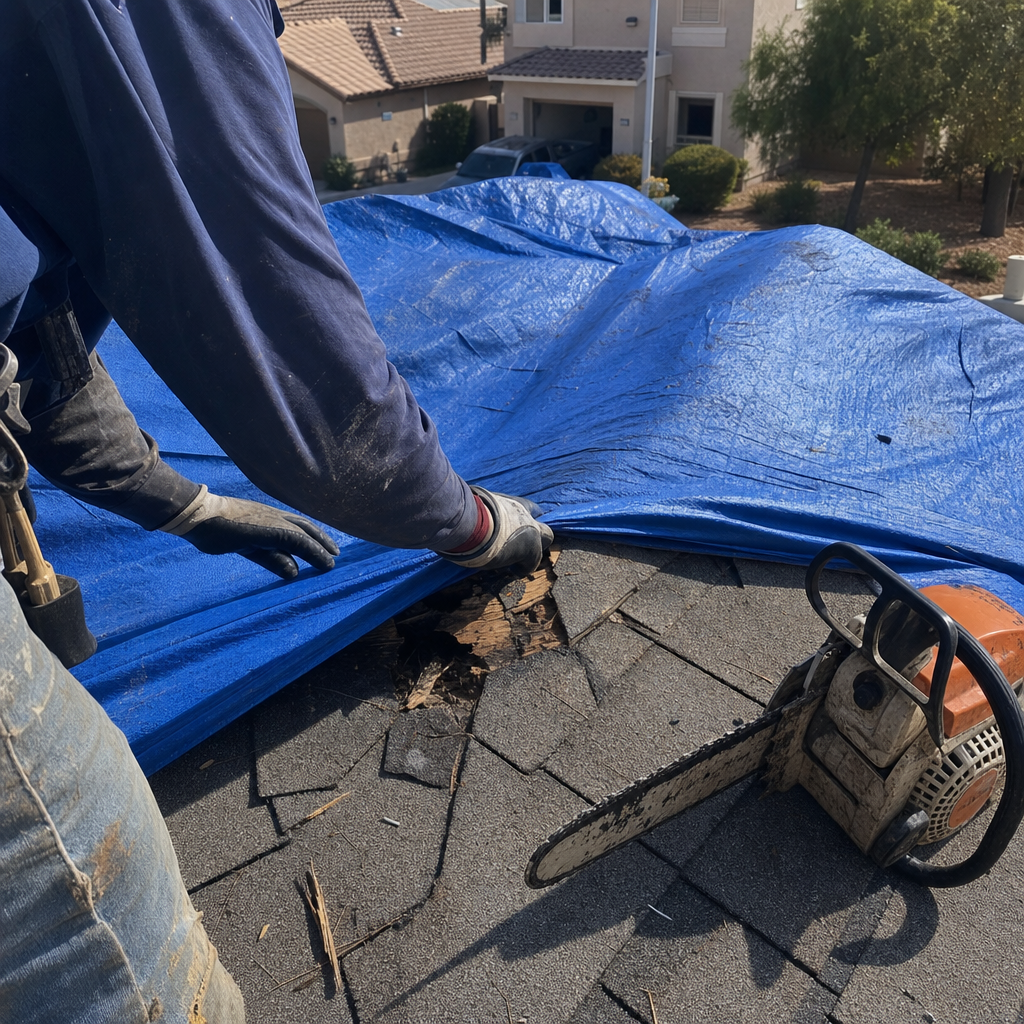
After that high-wind event channeled through the corridor between Sunrise Mountain and the Spring Mountains, our crew — already credentialed and pre-cleared — was dispatched to a mid-20th-century residential unit in the Sunrise housing area where sustained uplift had torn edge flashing away from a low-slope roof and opened a seam along a penetration that vibration fatigue had already begun to crack. We deployed an emergency tarp rated for desert UV and secured it per DoD Unified Facilities Criteria while our materials team pulled pre-positioned GAF membrane stock from our off-base staging location. That approach let us complete a permanent seam repair and re-flash the penetration within the same coordinated access window — rather than waiting days for a second credentialing cycle.
A tarp that isn’t rated for Mojave summer conditions isn’t a solution — surface temperatures on dark Nellis AFB roofing routinely exceed 165°F, and standard poly tarps degrade within weeks. We use UV-stabilized, heavy-duty materials and secure them to UFC spec every time.

Storm Damage Repair
Storm damage on Nellis Air Force Base structures tends to be more complex than what we see along South Hollywood Boulevard or East Craig Road, because the failure modes are compounding: wind opens a seam that vibration from F-35 and aggressor-jet overpressure had already weakened, and desert UV has been working on the surrounding membrane for years. We assess the full damage picture — not just the visible breach — before quoting a repair. On Sunrise housing units, we regularly find that what looks like a wind failure is actually a vibration-fatigued sealant fracture around an HVAC curb or pipe penetration that a wind event finally finished off.

Insurance Claims Assistance
Filing a damage claim for an on-base structure involves two parallel documentation tracks: your personal renters or supplemental insurance if applicable, and the government facilities reporting process through base housing or the civil engineer squadron. We photograph and document damage systematically, produce written assessments that satisfy both civilian insurance adjusters and DoD facility managers, and can work directly with your insurer to support your claim. Homeowners on the civilian side near Las Vegas Freeway access who have government-leased housing should ask us specifically about dual-track documentation — it’s a common point of confusion.

Wind Damage Repair
The Bruce Woodbury Beltway corridor and the gap between Sunrise Mountain and the Spring Mountains create a natural wind channel that regularly produces uplift events capable of failing edge flashing, pulling membrane seams, and dislodging poorly secured fascia. On UFC-governed structures, re-fastening with civilian-spec hardware is a code violation that will fail the next uplift cycle — we carry DoD-approved fastener specs and flash to the correct standard the first time. Wind damage at Nellis AFB that gets a civilian-spec patch is just damage waiting to reopen.

What happens when you call
- 1
A real person answersNo phone trees — you reach a local pro.
- 2
You get an upfront price rangeHonest numbers before anyone is dispatched.
- 3
A background-checked tech heads outLicensed & insured, dispatched right away.
- 4
You approve before work beginsNothing starts until you say go.
Trusted Brands We Service in Nellis Air Force Base
For emergency and storm repairs on Nellis Air Force Base structures, material selection is driven by UFC approval requirements and desert performance data — not brand loyalty. We work with GAF, CertainTeed, Owens Corning, IKO, Atlas, Tamko, and Boral, which means we can match approved membrane types, shingle classifications, and underlayment specifications to what the installation’s civil engineer squadron will accept. Because we stage materials off-base in advance, Nellis AFB clients aren’t waiting on a distributor order when an access window is already open and a roof is exposed.
Common Emergency & Storm Damage Problems We See in Nellis Air Force Base Homes
- Vibration-fatigued sealant fractures around HVAC curbs and pipe penetrations. F-35 and aggressor-jet overpressure cycles crack elastomeric caulk on Sunrise housing roofs far faster than anything we see on comparable flat-roof stock along South Hollywood Boulevard — the moment a wind event brings rain, those micro-fractures become open water pathways into the insulation assembly. By the time standing water is visible inside, you’re often looking at a full-section membrane replacement instead of a tube of caulk.
- Edge flashing uplift on low-slope government-built units during corridor wind events. UFC flashing specifications differ from Clark County residential norms, and contractors who don’t know the difference re-fasten with civilian-spec hardware that fails the next uplift cycle. We’ve corrected this exact problem on multiple Sunrise-area units — the fix isn’t complicated, but knowing which spec applies is everything.
- Delayed damage discovery due to restricted base access. A fastener loosened by a morning’s flight operations may sit unnoticed for weeks because nobody can get on the roof to check it. By the time the next inspection window opens, standing water has compressed the insulation assembly and what would have been a $300 fastener-and-sealant repair becomes a $4,000 section replacement. Pre-scheduled inspection windows are the only real defense.
- Accelerated UV degradation on standard asphalt shingles in Sunrise family housing areas. At this desert latitude with dark roofing surfaces hitting 165°F, standard asphalt shingles degrade in roughly 8–12 years — well short of their rated lifespan in milder climates. Residents who moved into a unit with a “recently replaced” roof may not realize the clock ran faster here, and storm damage to an already-degraded field is harder to patch reliably than it looks.
Pricing for Emergency & Storm Damage in Nellis Air Force Base, NV
Emergency work at Nellis Air Force Base carries a real coordination cost that honest pricing has to reflect. Here’s what the Nellis AFB market typically looks like:
- Emergency tarp installation (low-slope residential unit): $350–$650, depending on roof area and UFC securing requirements
- Vibration-fatigued sealant repair around penetrations (per penetration): $180–$450, depending on caulk depth, curb condition, and whether flashing must be lifted
- Edge flashing replacement (UFC-spec, per linear foot): $22–$40/LF — higher than civilian residential due to approved-material requirements
- Wind damage repair — membrane seam and re-flash (flat/low-slope): $600–$2,200, depending on seam length and penetration complexity
- Full low-slope section replacement (Sunrise housing unit, per 100 sq ft): $480–$950, depending on insulation assembly condition found after membrane removal
The access-coordination factor — pre-credentialing, scheduling through the civil engineer squadron, off-base material staging — adds lead time that reactive contractors can’t absorb. We build that into a structured service agreement rather than an emergency surcharge. Call (725) 373-5602 for a free, no-obligation assessment; we’ll tell you exactly what we’re seeing and what it costs to fix it.
We Also Serve Cities Near Nellis Air Force Base
Our work extends well beyond the base perimeter. We serve homeowners throughout Sunrise Manor, where many Nellis-affiliated families live off-base, as well as across North Las Vegas and Las Vegas proper. If you’re dealing with storm damage anywhere in the region — on-base or off — the same Karen Gomez-led team and the same material quality applies.
Serving Nellis Air Force Base, NV — Our Local Coverage Area
We’re based in the Nellis Air Force Base area and know this community well. Use the map below to see our service coverage — if you’re nearby, we can almost certainly help.
FAQs — Emergency & Storm Damage in Nellis Air Force Base
Same-day response inside the fence line is only possible because we’ve already done the credentialing work before the emergency happens. Unannounced contractor access at Nellis Air Force Base is prohibited — the installation’s civil engineer squadron controls access, and a contractor without pre-cleared credentials simply cannot get on-base, regardless of how urgent the situation is. Our personnel are pre-credentialed and our materials are staged off-base, so when a storm event happens, we’re not starting the paperwork from scratch. We coordinate the access window through proper channels as quickly as the installation allows, which is meaningfully faster than any contractor starting cold. Call (725) 373-5602 immediately after damage occurs — the sooner we open the coordination process, the sooner we’re on your roof.
The Sunrise housing area sits directly under the flight path of one of the most active tactical fighter wings in the country — F-35s, aggressor jets, and the Thunderbirds all generate overpressure and vibration cycles that progressively fracture elastomeric sealants around roof penetrations. This is a failure mode that simply doesn’t exist at the same intensity on civilian residential stock along East Craig Road. Combine that with Mojave UV exposure degrading the sealant’s base flexibility, and cracks that would take a decade to form elsewhere appear in two or three years on Sunrise housing roofs. Pre-scheduled annual inspections targeting penetrations and HVAC curbs are the most cost-effective way to stay ahead of it.
Clark County building codes do not govern Nellis Air Force Base structures — all work on-base must comply with DoD Unified Facilities Criteria (UFC), which specifies approved materials, insulation R-values, and installation methods independently of civilian permitting. Emergency repairs must use UFC-compliant membranes, fasteners, and flashings; substituting Clark County residential-spec hardware is a code violation that will be flagged by the civil engineer squadron and will likely fail the next wind event. We carry specifications for UFC-approved materials across multiple product lines — including GAF and CertainTeed membrane systems — and can document compliance for the installation’s records. A contractor who quotes a repair without mentioning UFC requirements almost certainly hasn’t done this work on-base before.
Document immediately and from multiple angles: photograph the damage from ground level, capture any interior water intrusion evidence, and note the date and time relative to the wind event. On-base housing damage typically routes through two tracks — a facilities work order through your housing office or the civil engineer squadron, and your personal renters or supplemental insurance if you carry it. We produce written damage assessments with timestamped photo documentation that satisfies both civilian insurance adjusters and DoD facility reviewers. Don’t delay reporting; base housing offices often require a facilities ticket to be opened before any contractor can be authorized for access, and the sooner that ticket exists, the sooner the access window can be scheduled. Call (725) 373-5602 and we’ll walk you through the documentation sequence.
It depends on the membrane’s age and condition beneath the visible storm damage — but honest answer: if a Sunrise housing unit’s roof membrane is more than 10–12 years old, full-section replacement is frequently the more cost-effective path, because patching a storm breach in a UV-degraded field often just relocates the next failure point rather than eliminating it. At 165°F+ summer surface temperatures and constant UV exposure, flat membrane stock on these mid-20th-century units ages faster than manufacturer ratings suggest. We’ll assess the membrane’s overall condition — not just the storm-damaged section — and tell you directly whether a repair is a genuine fix or a short-term patch. That assessment is free. Call (725) 373-5602 to schedule it.
Reviewed by Karen Gomez, Owner & Lead Technician at Premier Roofing & Construction, serving Nellis Air Force Base, NV and the greater North Las Vegas area since 2011.