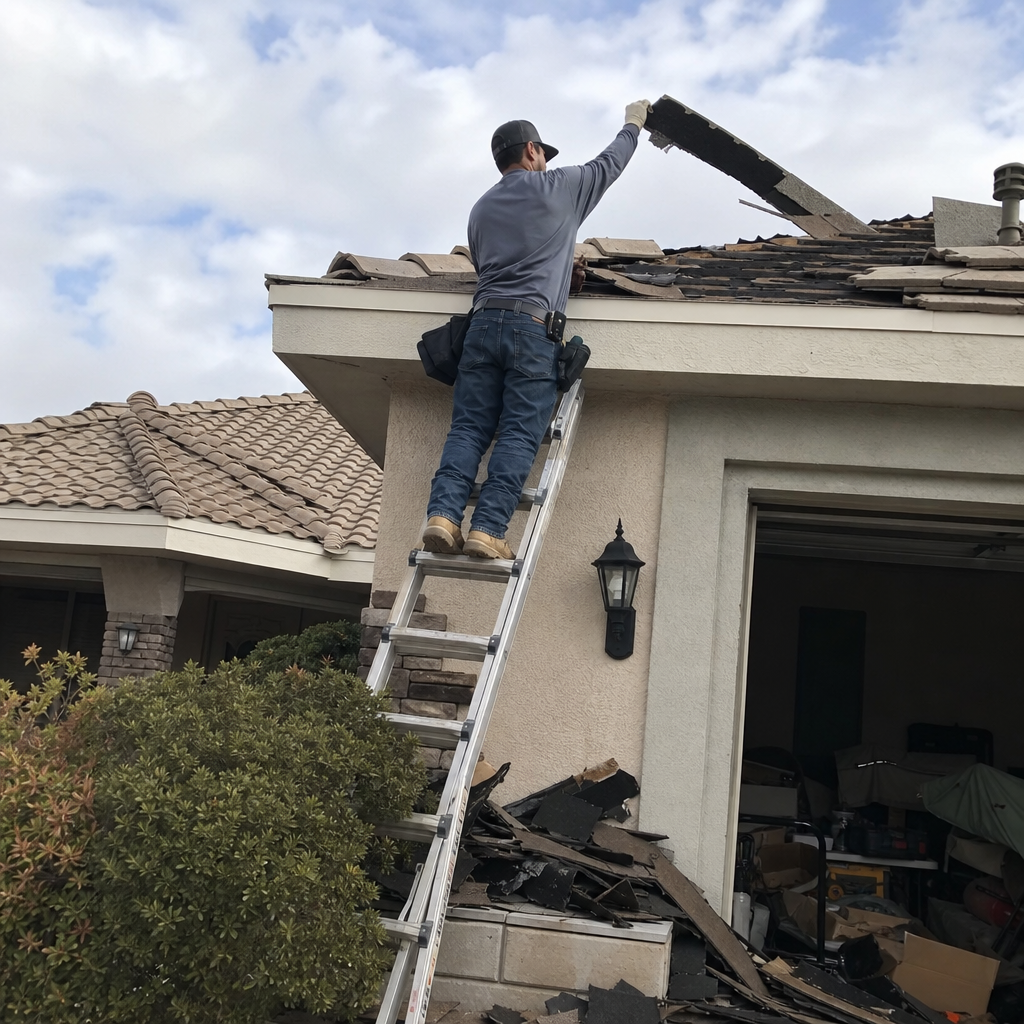
Emergency & Storm Damage in Las Vegas, NV
When a monsoon cloudburst or desert windstorm tears through Las Vegas, the damage shows up fast — and in this city’s older housing stock, it shows up in ways that aren’t always obvious from the street. Premier Roofing & Construction responds to emergency storm damage calls across Las Vegas, from the 89101 corridor near East Charleston Boulevard to neighborhoods like Bonanza Village and the Arts District. Our Emergency & Storm Damage team moves quickly because we know every hour of standing water on a nearly-flat BUR roof is an hour closer to ceiling damage. Call us now at (725) 373-5602.
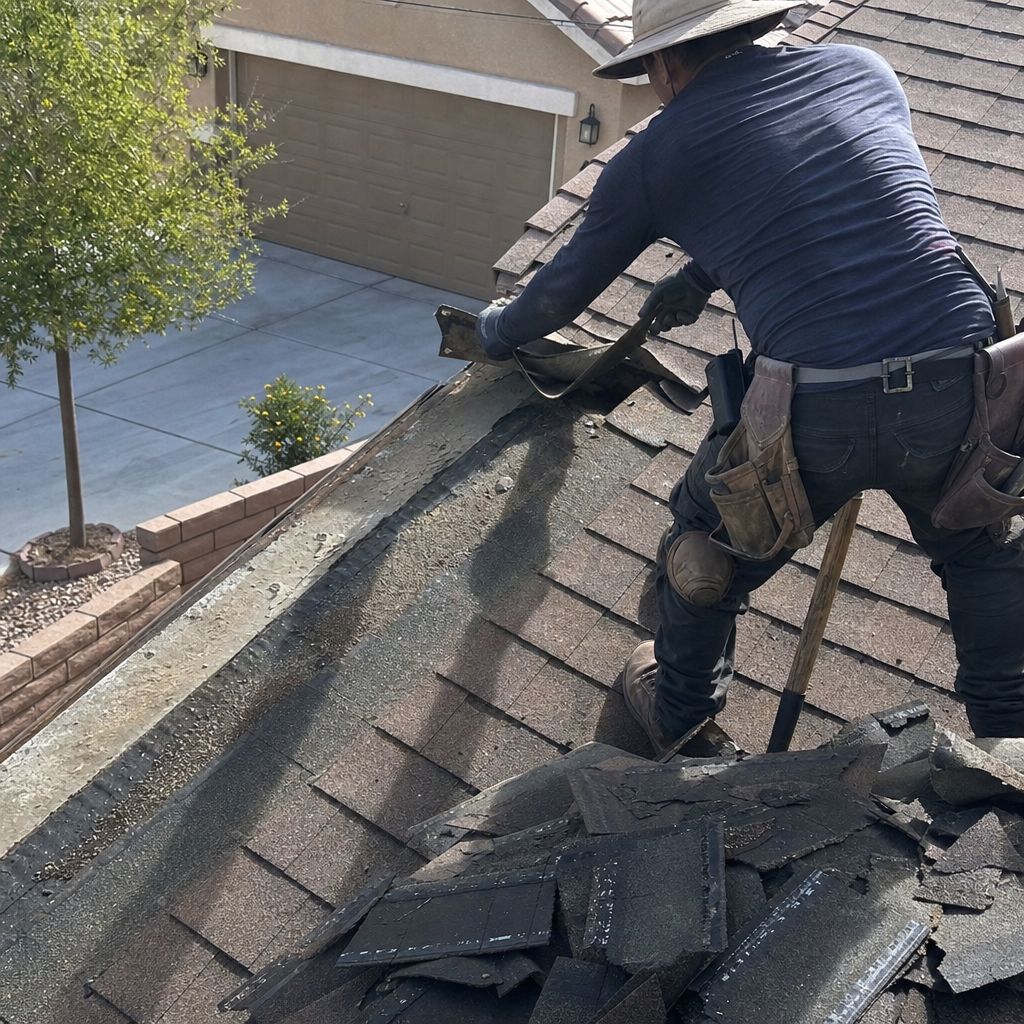
Why Premier Roofing & Construction Is Las Vegas’s Preferred Emergency & Storm Damage Company
Karen Gomez, our owner and lead technician, has spent 14 years working roofs across the Las Vegas valley — she understands that a monsoon leak in a 1960s flat-roof home in the 89106 ZIP code is a completely different animal than storm damage on a newer tile roof in a master-planned community. That local knowledge shapes every emergency call we take. When you reach us, you’re not talking to a dispatcher who hands the work to an unknown crew. Karen leads the response directly.
613 Las Vegas-area homeowners have left us a perfect 5-star rating across verified reviews — not because we showed up with the lowest number, but because we showed up at all, at the right time, and did the work correctly. Our Emergency & Storm Damage in Las Vegas service area spans the full valley, covering zip codes 89101 through 89108, and we’ve built the kind of reputation that means homeowners call us back on the next storm — and send their neighbors our way before that.
Our Emergency & Storm Damage Services in Las Vegas
Emergency Tarp Installation
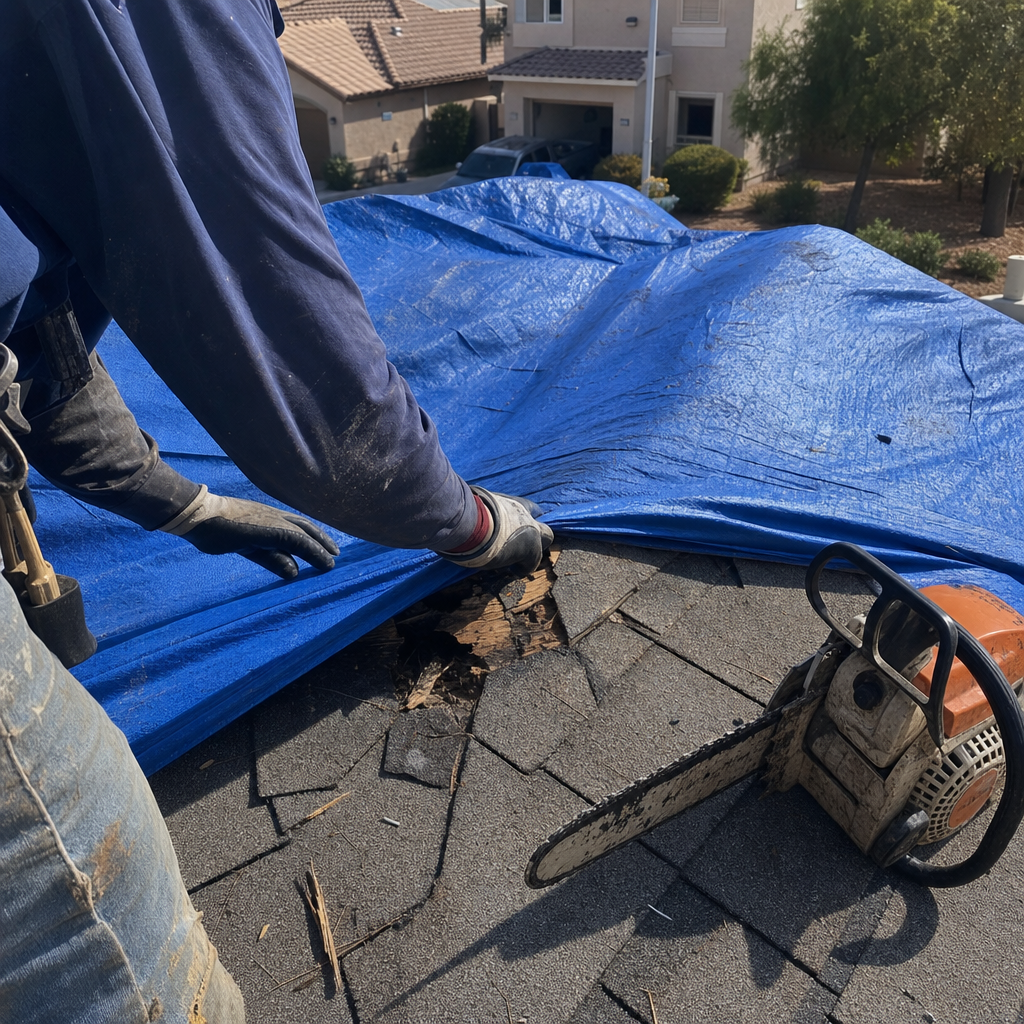
A quality emergency tarp isn’t a blue plastic sheet thrown over a problem — it’s a calibrated temporary barrier installed correctly so it doesn’t become its own source of damage. In Las Vegas’s July heat, where daytime temperatures regularly exceed 115°F, improper tarp anchoring on a flat or low-slope roof can create additional membrane stress almost immediately. We arrive, assess the low points, and secure heavy-duty tarping to stop water intrusion while the full repair is planned — and we document everything with timestamped photos from the start, which matters directly for insurance claims.

Storm Damage Repair
Las Vegas storms tend to expose failure modes that were already forming beneath the surface. A monsoon gust doesn’t just lift a healthy tile — it lifts one whose mortar cap has been deteriorating quietly for two or three summers. Our storm damage repair process starts with a full deck inspection, not just the visible break point, so we’re addressing the actual failure rather than patching over a symptom. We work with GAF, CertainTeed, Owens Corning, IKO, Atlas, Tamko, and Boral materials, which means the repair matches the system rather than defaulting to whatever we happen to have on the truck.

Insurance Claims Assistance
Filing a storm damage claim in Las Vegas without solid documentation is one of the fastest ways to get a lowball settlement or an outright denial. We walk through the documentation process with you — timestamped photos, written damage scope, and a contractor assessment letter your adjuster can work from — because we’ve seen what happens when homeowners try to handle this piece without support. Our 14 years of storm response work in this market means we know what adjusters look for under Nevada wind-and-storm riders, and we structure our documentation to match those requirements.

Wind Damage Repair
Along North Rancho Drive and through the Buffalo Ranch neighborhoods, the older tile roofs from the 1980s–90s building boom take the brunt of monsoon-driven gusts. Wind damage on a tile roof is particularly deceptive: tiles can shift or crack without fully dislodging, leaving the underlayment exposed in ways that are invisible from ground level but allow storm water to reach the deck on the next hard rain. We inspect the full field, not just the obvious breaks, and we replace deteriorated underlayment — not just reset the tiles — so the repair actually holds.

What happens when you call
- 1
A real person answersNo phone trees — you reach a local pro.
- 2
You get an upfront price rangeHonest numbers before anyone is dispatched.
- 3
A background-checked tech heads outLicensed & insured, dispatched right away.
- 4
You approve before work beginsNothing starts until you say go.
Trusted Brands We Service in Las Vegas
Premier Roofing & Construction works with seven major roofing material lines — GAF, CertainTeed, Owens Corning, IKO, Atlas, Tamko, and Boral — which gives Las Vegas homeowners a real choice rather than a forced recommendation. In a market where spray polyurethane foam (SPF) systems and elastomeric cool-roof coatings dominate the flat-roof inventory, and where concrete and clay tile cover most of the 1980s–2000s homes, material matching matters. We stock materials suited to Las Vegas’s specific system types so emergency repairs move forward without supply delays.
Common Emergency & Storm Damage Problems We See in Las Vegas Homes
- Monsoon ponding on near-zero-slope BUR roofs in the 89106/89107 corridor: The 1950s–60s flat-roof homes along East Charleston Boulevard and throughout Bonanza Village were engineered with as little as 1/8 inch of slope per foot — a design assumption that rainfall was essentially a non-event. When the monsoon delivers two inches in an hour, water ponds for 48–72 hours and wicks through failed felt seams in ways that a dry-season inspection will never catch, making August the peak month for emergency leak calls from this part of the valley.
- Wind-lifted tiles on aging early-2000s roofs in Canyon Gate and Desert Shores: Tile roofs that are now 20–25 years old have mortar caps and underlayment that have been degrading beneath intact-looking tile surfaces. A monsoon gust exposes the underlayment, storm water reaches the deck, and the homeowner sees a living room ceiling stain before they notice anything wrong on the roof itself.
- SPF cool-roof coating failure accelerated by summer UV: Las Vegas’s elastomeric topcoats on SPF systems degrade two to three times faster than the national average under sustained 115°F summer heat. Cracking and delamination look minor in the dry season — until the first July cloudburst turns a surface crack into an active leak through the foam layer beneath.
- Clogged or undersized interior roof drains on mid-century flat roofs: The original drain specifications on 1950s flat-roof homes in neighborhoods like Charleston Heights were sized for low-rainfall assumptions. Decades of gravel ballast migration and organic debris accumulation reduce flow capacity to near zero, so even a moderate monsoon event overwhelms the system and creates ponding that wouldn’t occur on a properly drained flat roof of the same slope.
The Las Vegas Flat-Roof Problem Nobody Talks About
This is worth a full explanation because it drives a disproportionate share of emergency calls in this city. Las Vegas has an unusually high concentration of flat and low-slope residential roofs — a product of the desert modernist and Spanish Colonial architecture that defined the postwar building boom. Those 1950s–60s homes in neighborhoods like Bonanza Village and along East Charleston Boulevard were built with slopes so minimal — often 1/8 inch per foot — that the original builders essentially treated annual rainfall as a rounding error. The roofing systems installed on them, typically built-up roofing (BUR) with tar-and-gravel membranes, are now 50–70 years old, and many have never been fully replaced, only patched.
When the North American Monsoon arrives in July, it doesn’t trickle — it drops intense cloudbursts that can deliver an inch or more within an hour. A roof with a choked interior drain and a failed felt layer underneath aging gravel ballast doesn’t have a chance. The water ponds, sometimes for two to three days, and hydrostatic pressure forces it through every micro-failure in the membrane. Our crew responded to exactly this scenario at a Charleston Heights home on East Charleston Boulevard after a late-July cloudburst: standing water covered the entire original BUR membrane, gravel ballast had migrated directly over the interior drains, and water had already reached the living room ceiling. We tarped the low-point quadrant the same night, cleared and re-sleeved the clogged drains the next morning, and produced full timestamped photo documentation to support the homeowner’s insurance claim. That sequence — tarp, drain repair, documentation — is exactly the protocol that gets claims paid and roofs fixed correctly.
This failure pattern simply does not occur with the same frequency in neighboring Henderson or North Las Vegas, where the housing stock and roof slopes differ. It’s a Las Vegas-specific problem, concentrated in the 89106 and 89107 ZIP codes, and it requires Las Vegas-specific expertise to address.
Pricing for Emergency & Storm Damage in Las Vegas, NV
Emergency roof services in Las Vegas carry a range that reflects the type of system involved, the scope of damage, and whether the work is temporary stabilization or a full repair. Here are honest ranges for this market:
- Emergency tarp installation (flat or low-slope roof): $350–$700 depending on roof area and access difficulty
- Monsoon ponding / BUR repair (felt layer and drain clearing): $800–$2,500 for localized repairs; full membrane sections run higher
- Wind-damaged tile replacement with underlayment repair: $600–$2,000 for typical section failures on a mid-sized Las Vegas tile roof
- SPF cool-roof coating repair (cracking / delamination): $900–$3,500 depending on the extent of topcoat failure and foam condition beneath
- Insurance claim documentation and scope preparation: Included with repair services — we don’t charge separately for the documentation that supports your claim
Storm damage claims through your homeowner’s insurance can offset a significant portion of these costs — and how that claim is documented at the outset matters enormously to the outcome. Call (725) 373-5602 for a free on-site estimate; we’ll assess the damage, give you an exact number, and explain what your insurance policy is likely to cover before any work begins.
We Also Serve Cities Near Las Vegas
Premier Roofing & Construction’s emergency storm response extends beyond Las Vegas to nearby North Las Vegas, Sunrise Manor, and the area around Nellis Air Force Base. If you’re in any of these communities and dealing with active storm damage or a monsoon-related leak, the same crew and the same response process applies — call (725) 373-5602 and we’ll get someone out.
Serving Las Vegas, NV — Our Local Coverage Area
We’re based in the Las Vegas area and know this community well. Use the map below to see our service coverage — if you’re nearby, we can almost certainly help.
FAQs — Emergency & Storm Damage in Las Vegas
August is the peak of the North American Monsoon season, which delivers intense, brief cloudbursts to the Las Vegas valley — often an inch or more of rain within a single hour. The problem is that a large portion of Las Vegas’s residential housing stock, particularly the flat-roof homes built in the 1950s and 60s in neighborhoods like Bonanza Village and along the East Charleston Boulevard corridor in ZIP codes 89106 and 89107, was engineered with near-zero slope and sized for desert rainfall assumptions that no longer hold. When those original BUR membranes and undersized drains meet a monsoon event, the result is ponding that persists for 48–72 hours and eventually forces water through failed felt seams. A dry-season inspection won’t show you this failure mode — but the first August cloudburst will. Call (725) 373-5602 if you’re already seeing water inside.
The tile itself is probably intact, but the underlayment beneath it has likely deteriorated. The early-2000s tile roofs in Canyon Gate are now 20–25 years old, and the mortar caps and underlayment layers have been degrading for years under Las Vegas’s UV load. A monsoon gust doesn’t need to break or remove a tile to create a leak — it only needs to shift it slightly or find the gap where mortar has crumbled, exposing the deteriorated felt beneath. Water reaches the deck before anything looks wrong from ground level. We inspect the full field and replace the underlayment in failed sections, not just reset the visible tile. Call (725) 373-5602 to schedule an assessment.
Yes — and we’d argue this is one of the most important parts of the service. We produce timestamped photo documentation, a written damage scope, and a contractor assessment letter structured to support your claim under a Nevada wind-and-storm rider. Insurance claim outcomes in Las Vegas are heavily influenced by the quality of the initial damage documentation — an adjuster working from a vague verbal description and a few phone photos will produce a very different settlement than one working from a detailed professional scope. We include this documentation with our repair services because an underpaid claim is ultimately your problem, not ours, and we’ve seen too many Las Vegas homeowners shortchanged by inadequate documentation at the start. Call (725) 373-5602 to get the process started correctly from day one.
We prioritize active leak calls and aim to reach flat-roof emergencies in the 89107 corridor — including Charleston Heights and the surrounding East Charleston Boulevard area — the same day you call, with evening response available for calls received before 6 p.m. during monsoon season. Once on site, a properly anchored emergency tarp on a flat or low-slope roof typically takes two to three hours to install correctly. We don’t rush the anchoring — a tarp that fails or causes additional membrane damage in a follow-up windstorm is a worse outcome than one that takes an extra hour to secure. Call (725) 373-5602 now if you have standing water or an active interior leak.
The decision hinges on the condition of the foam layer beneath the elastomeric topcoat. If UV cracking or storm damage has only compromised the topcoat — the outer elastomeric membrane — a recoat with a new elastomeric layer is a legitimate repair that restores both the weather barrier and the system’s solar reflectance, typically running $900–$2,500 for a standard Las Vegas residential roof. If the foam itself has absorbed moisture, delaminated, or been mechanically damaged by hail or debris, a section-by-section foam replacement becomes necessary before recoating, which moves the cost into the $3,000–$6,000+ range depending on scope. The difference is not visible without probing — surface cracking looks the same whether the foam beneath is intact or compromised. We assess both layers on every SPF inspection so the recommendation reflects what’s actually happening below the surface. Call (725) 373-5602 for a free estimate and a straight answer on which path your roof actually needs.
Get Your Las Vegas Roof Assessed Today
If a monsoon, windstorm, or heat event has damaged your Las Vegas roof — or if you suspect a problem that hasn’t fully shown itself yet — the right move is a professional assessment before the next storm arrives. Karen Gomez and our team serve Las Vegas homeowners from ZIP codes 89101 through 89108, and we bring 14 years of direct field experience with this valley’s specific roof types, climate conditions, and housing stock. Call (725) 373-5602 for a free, no-obligation estimate. We’ll tell you exactly what’s happening on your roof, what it will cost to fix it, and how to document it for your insurance carrier if a claim is appropriate.
Reviewed by Karen Gomez, Owner and Lead Technician at Premier Roofing & Construction, serving Las Vegas, NV and surrounding communities since 2011.